




AI is transforming how non-coders build apps and makes the process faster and more accessible than ever.
But with AI-assisted development integrated into WeWeb’s no-code editor since April 2023, and after speaking with hundreds of builders, we understand AI alone isn’t enough.
In this article, we share our view on the current state of the no-code & AI industry, and where we believe it’s heading.
AI is changing the picture
To better explain this direction, we’ll use the concept of floor and ceiling.
Floor and ceiling are a way to describe how easy it is to start building something (the floor) and how far you can go with it (the ceiling):
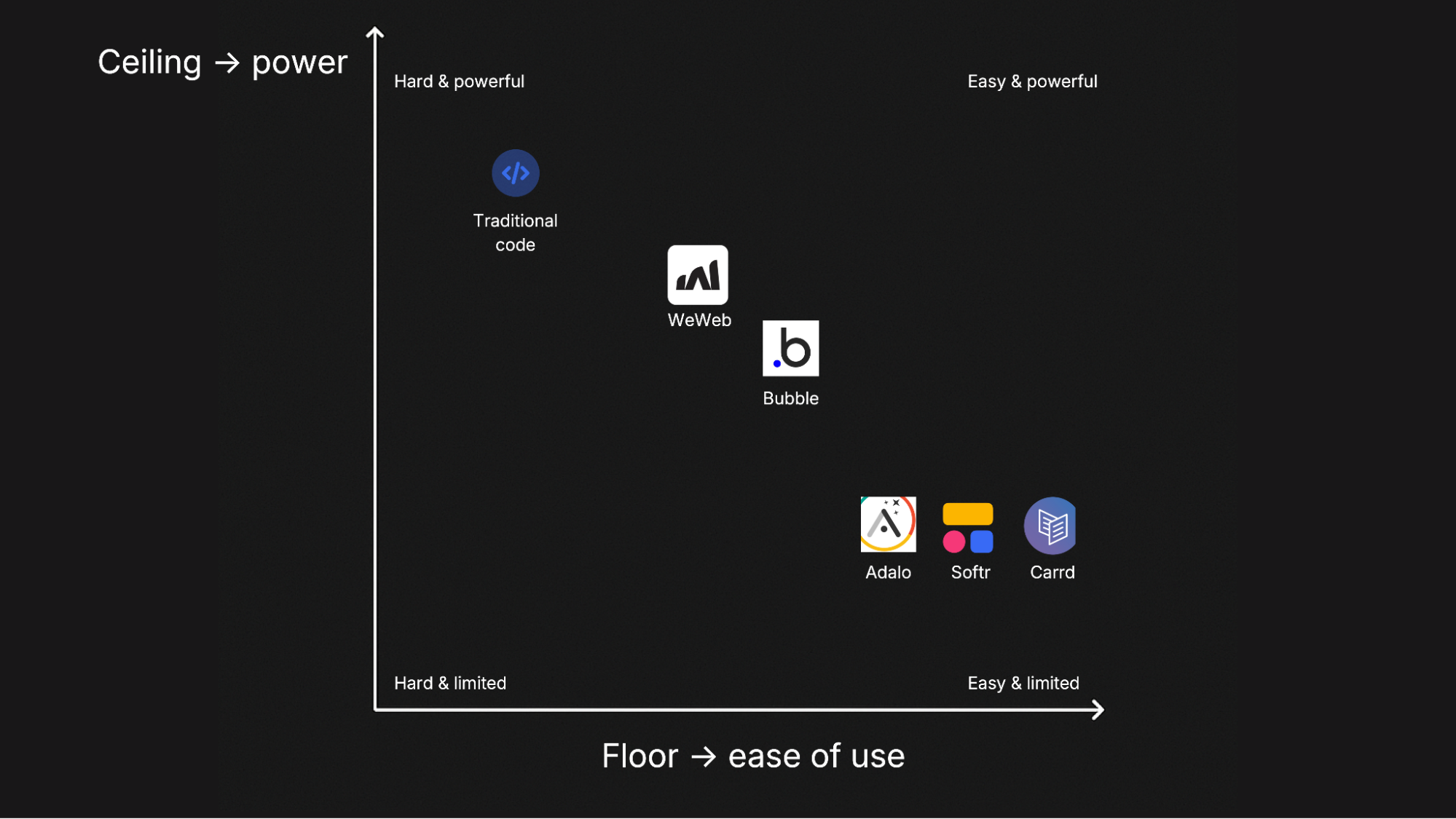
No-code tools like Adalo, Softr or Carrd, sit in the lower floor and lower ceiling corner: it’s easy to get started, but there are limits to what you can build.
More customizable no-code tools like Bubble or WeWeb fit into the higher floor and moderate ceiling corner: they expand what you can build, but are also harder to learn.
Then we have traditional code, the classic high floor high-ceiling world where you can build anything, but the path to mastery takes years.
For a long time, these were the only options, and the low floor high ceiling dream felt elusive. But AI is changing that picture.
AI’s magic and its limits
For coders, AI is an accelerator and an assistant.
For non-coders, it’s an enabler. That’s why so many of them gravitate toward vibe coding platforms. Within the low floor, high ceiling framework, these tools seem to perform best. With almost no learning curve and a bit of prompting, anyone can turn an idea into a fullstack app in minutes.
Until cracks start to show. People fall into prompting loops, trying to explain what they mean and hoping the AI will understand. And when something breaks, they can’t tell what happened or how to fix it. The building process turns into endless prompting (and praying) until things work again — or don’t.
As the hype settled, it became clear that the “high ceiling” of vibe coding platforms isn’t actually that high for non-coders, especially when they try to build production-grade apps.
Yes, you can spin up an impressive prototype in seconds, but what do you do with it afterward?
Which leads to the obvious question: what kind of platform can take the low floor, high ceiling promise to production for non-coders?
In our opinion, only platforms that give you a low floor through AI and a high ceiling through full control of the output at every step.
And what can give that control to non-coders? Visual interfaces.
The last 5%
No, visual interfaces aren’t disappearing. They’re becoming more critical.
Even if AI takes you to 95%, non-coders still need visual interfaces to understand what was built and finish the last 5% with confidence.
If you don’t understand how it was built, you don’t own it. And if you don’t own it, you’re in trouble. For a quick prototype or a small non-critical app, sure, it’s fine. But for anything business-critical, you need understanding and ownership.
That’s why the interface layer in WeWeb is so important, and why we put so much effort into making sure it works in harmony with AI.
Additionally, tools like WeWeb aren’t just builders. They’re fullstack platforms that handle hosting, deployment, DevOps, multi-environment, maintainability, and security — all exposed through a visual layer that makes these capabilities easier for non-coders to understand and control.
Can vibe coding platforms add a visual layer?
So why don’t vibe coding tools just add a visual layer on top of the AI-generated code?
The short answer: they’re trying but, for now, the visual editing options remain very basic because they’re running into serious limitations.
For any platform to put a visual editor on top of code, the code structure has to be deterministic: you need to know exactly how it’s written, how components behave, and how the application is architected.
But AI is non-deterministic by nature, which means you never really know what the code will look like. You can ask it to output React, but you don’t know exactly how it will code a button, implement an interaction, or structure the app. There are often hundreds of valid ways to do the same thing, and AI might pick any of them.
The exception is basic CSS and HTML. Those outputs are stable enough that you can layer simple visual controls on top. And that’s why vibe coding tools today let you visually tweak things like button colors or text but can’t yet provide interfaces to edit advanced CSS and logic visually.
WeWeb took a deterministic approach. We can put a full visual editor on top of the code because we know what the code will be. We know it’s Vue.js. We know the exact type of button the system outputs. We know how every component is written, how interactions are structured, how the entire application behaves.
Could vibe coding tools adopt the same approach? Theoretically, yes. But to do that, they would have to give up the non-deterministic nature of their code generation. They would also have to give up being agnostic to frameworks like React, Angular, Vue, or Next. And they would need to introduce friction into the generation process.
In other words, they would have to fundamentally change their architecture and become what no-code platforms are today.
The hybrid future of building
The hybrid model of AI and visual development is a sweet spot for non-coders: it gives you the best of both worlds.
You have existing elements you can drag-and-drop, you can use AI to scaffold and accelerate things, and you can still go in and touch every element or piece of logic to make changes manually. You’re fast because of AI, but you stay in control thanks to the visual layer.
We believe this hybrid model is what will finally make the low-floor, high-ceiling dream a reality for non-coders.
In this future, what will be the best tool for you?
It depends on your needs and technical background.
Some users will prefer to take the full AI route (“I don’t want to hear about how it’s built, just let the AI do everything”). Others will want control and won’t feel comfortable relying entirely on an AI agent.
And because these needs are so different, the industry won’t settle on one solution.
There will be quite a few players with different approaches. Some are coming from AI-native roots, some from multi-modal direction, and nobody is doing it perfectly yet. But all are working toward the same North Star: speed and control.
At WeWeb, we firmly believe that visual interfaces are a critical piece of the mix, even if they evolve and don’t look like what we have today.
Once we have the right blend of AI to accelerate development and visual interfaces that give non-coders full control, we’ll finally reach a point where the floor for building is very low and the ceiling incredibly high.
At that point, almost anyone will be able to bring their ideas to life, and that’s exactly the future we’re building toward.