



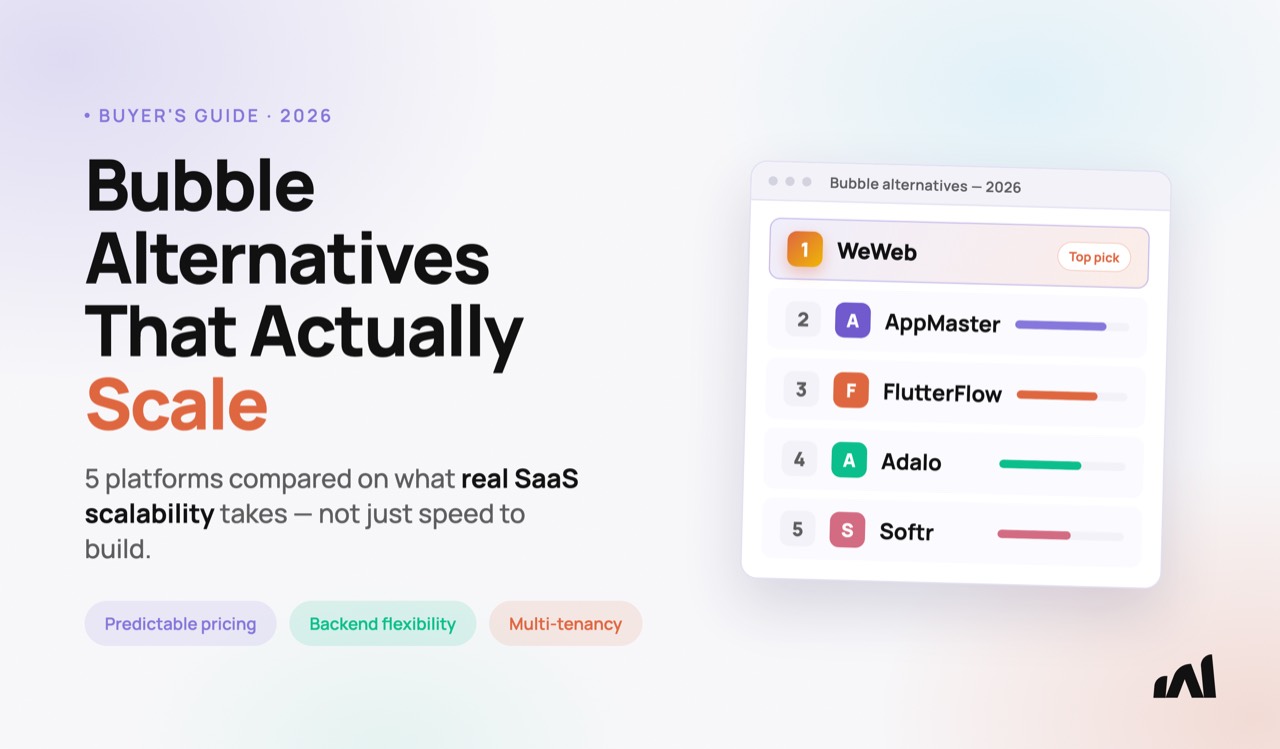
Bubble is one of the most popular platforms for launching a SaaS product.
But as products grow, you may start running into limitations around pricing predictability, scalability, and long-term flexibility.
This guide evaluates Bubble alternatives against five scalability factors.
Why "Fast to Build" and "Scalable" Aren't the Same Thing
Before reviewing any platform, it helps to define what scalable actually means for a SaaS product:
- Performance architecture: does the underlying rendering tech hold up under load?
- Pricing at scale: what do costs look like at 1,000 or 10,000 users?
- Backend architecture: can you use real, production-grade infrastructure?
- Auth and multi-tenancy: can the platform handle proper per-user data isolation?
- Deployment flexibility: can you self-host for enterprise clients, run CI/CD, optimize globally?
We'll score each platform against these five factors. No platform is perfect, but the gaps matter a lot depending on your use case.
The 5 Scalability Factors That Matter for No-Code SaaS
Factor 1: Performance Architecture
What's rendering your app, and how does it behave under concurrent load?
Bubble uses a proprietary rendering engine that doesn't generate standard HTML/CSS/JS and that a CDN can serve efficiently. As user counts grow and UI complexity increases, performance can degrade.
Standard frameworks like Vue.js, React, and Flutter compile to optimized bundles that CDNs cache and serve globally. They benefit from years of performance tooling, browser optimization, and developer expertise.
This matters for SaaS because page speed directly affects user retention. A 3-second load time on your dashboard is a churn risk.
Factor 2: Pricing Model at Scale
Every SaaS product needs to model infrastructure costs. Per-user pricing and consumption-based models make that nearly impossible.
Bubble charges by workflow units: every action a user takes inside your app consumes units. With 10 users this is fine. With 2,000 monthly active users generating hundreds of actions each, costs become unpredictable fast.
On the other hand, seat-based pricing (who builds, not who uses) gives you predictable unit economics regardless of how many end users your SaaS serves.
Factor 3: Backend Architecture
Production SaaS needs real infrastructure: a proper relational database, Stripe for billing, third-party API integrations, maybe an internal API layer.
Bubble's proprietary database doesn't connect to Postgres, Supabase, or any external data store without replication workarounds.
Backend-agnostic platforms let you connect to any database or API. Your data architecture stays clean and compliant with your infrastructure requirements.
Factor 4: Auth and Multi-Tenancy
Scalable SaaS requires that User A cannot see User B's data. This isn't just authentication but a row-level data isolation and multi-tenant architecture.
Some of the no-code tools offer "login/signup" as a feature. However, that's not the same as enterprise-grade multi-tenancy with SSO, OIDC, and per-tenant data partitioning.
Factor 5: Deployment Flexibility
Enterprise clients often require self-hosting for data sovereignty and compliance. DevOps teams expect CI/CD pipelines. Users in different regions need edge-hosted assets for performance.
Vendor-hosted-only platforms block all of these. For many SaaS products, that's fine early on, but it becomes a blocker the moment you land your first enterprise deal.
Now, let’s take a look at the alternatives.
WeWeb: Scores Well Across All 5 Factors
WeWeb is a visual no-code app builder with AI generation, pixel-perfect design control, and full Vue.js code export. It's the platform that combines the speed of no-code with a clean path to handoff.
Scalability scorecard:
What makes WeWeb different for SaaS:
Code ownership is one of the deciding factors for most builders. You can export a complete Vue.js SPA at any time with no dependencies on WeWeb's platform. You get standard Vue.js 3 code not proprietary output or an unknown framework.
Performance also matters. WeWeb generates a Vue.js SPA served from a global CDN. No proprietary runtime, no bloated output. Load times are fast because the underlying technology is optimized for it.
Pricing at scale is flat. Unlimited app users on all paid plans. Whether your SaaS has 500 or 50,000 monthly active users, your WeWeb bill doesn't change. You pay for builder seats, not the people using what you built.
Backend flexibility. You can use WeWeb's native backend and/or connect to your existing infrastructure like Supabase, Xano, your own REST or GraphQL API, Stripe without migrating data.
Best for:
- Non-technical and technical founders who want production-grade SaaS.
- Product teams at growing companies validating new products before committing engineering resources.
AppMaster: Suitable for Full Code Generation
AppMaster generates production-ready Go backend code and Vue.js/React frontend code from visual models. It's closer to low-code than pure no-code.
Scalability scorecard:
AppMaster is the right choice when you want complete code generation from day one. It generates a real Go API backend alongside the frontend, giving developers the most to work with.
Best for:
- Technical founders or product teams with some developer involvement who want maximum code ownership and the option to take the codebase in any direction.
FlutterFlow: Best for Mobile-First Cross-Platform SaaS
FlutterFlow builds Flutter/Dart applications for iOS and Android simultaneously. If your SaaS is primarily a mobile product, this is the strongest option on the list.
Scalability scorecard:
The constraint is the Firebase ecosystem. Most FlutterFlow patterns assume Firebase as the backend. If your infrastructure is Postgres/Supabase, Xano, or a custom API layer, you'll be working against the grain.
Best for:
- Primarily mobile products, where iOS and Android are the core experience, not a secondary consideration.
Adalo: Simple MVP Fast
Adalo is a no-code mobile and web app builder with a very low learning curve. Good for the simplest possible first prototype but problematic for anything beyond early validation.
Scalability scorecard:
Adalo scores well on one thing: accessibility. Non-technical founders can launch a first app quickly. For early validation with a small user base, that's genuinely useful.
However, performance can degrade as complexity grows. Per-user pricing compounds as your SaaS scales.
Best for:
- The simplest possible first prototype to validate a market hypothesis. Plan to migrate before serious growth.
Softr: Fastest for Simple Airtable-Backed SaaS
Softr is a template-based app builder that layers a UI on top of Airtable, Google Sheets, or Notion data. It’s very fast for simple use cases, with a low ceiling.
Scalability scorecard:
Softr excels if you have data in Airtable already, you need a client-facing layer on top of it, and you need it live this week. For that specific situation, it's genuinely the fastest option.
The problems emerge fast when you try to grow. Airtable has row limits, API rate limits, and doesn't support the relational queries most SaaS products eventually need. Softr's user caps mean you'll upgrade plan tiers as your user base grows.
Best for:
- A simple, Airtable-backed SaaS to validate a concept. Know the ceiling before you commit.