With 235,000 employees and a history dating back to 1471, La Poste is one of France’s largest and oldest organizations.
Originally founded as a national postal service, the company has grown into a complex, multi-service ecosystem that handles mail, logistics, and banking at scale.
But that same scale and legacy made it hard to keep up with the pace of change.
To modernize a massive, legacy organization, La Poste had to rethink how it built and delivered digital services.
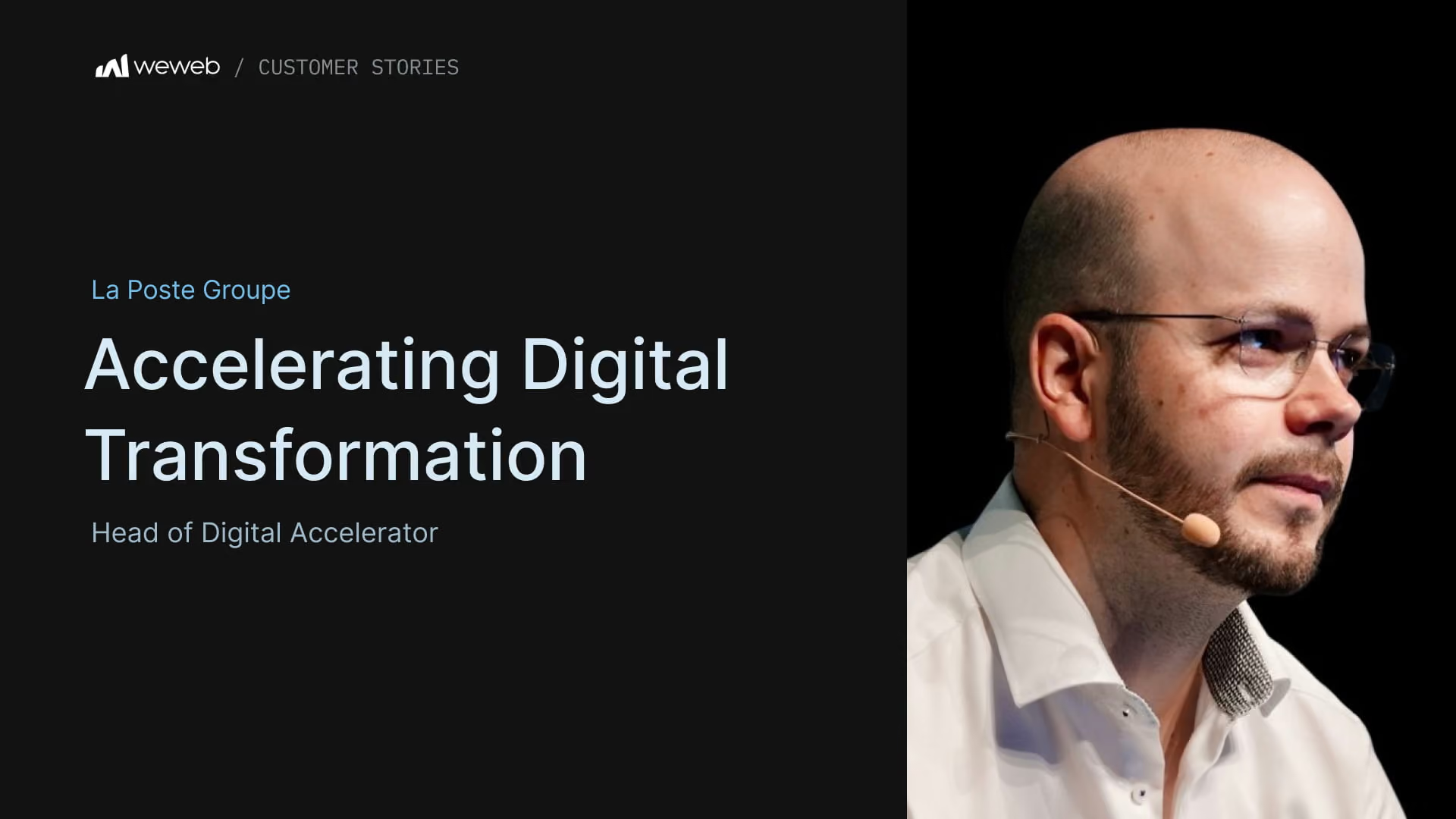
The responsibility for this transformation fell to Nicolas Fabre and his digital acceleration team.
And it started with a backend.
In 2013, La Poste set out to build its own backend-as-a-service platform for privacy-first IoT solutions, with Nicolas and his team leading the initiative.
At the time, the real opportunity in IoT wasn’t in manufacturing devices but in building the platforms that connected them. La Poste saw a chance to apply its logistics expertise and do the same for data.
The system was technically successful but never found product–market fit and ultimately failed commercially.
Nicolas and his team decided to pivot and repurpose the platform to connect and orchestrate La Poste’s internal legacy IT systems, such as banking networks and identity providers.
“The first major use case was a KYC platform for banks across France and Europe,” Nicolas recalls. “We saw it definitely had potential.”
After the pivot, Nicolas’s team powered most of La Poste’s internal digital projects with their backend platform.
However, they relied on other teams or external vendors to build frontends. This meant they could only target a narrow set of internal clients — those who could build their own frontends.
“I realized that to scale adoption, we needed to offer end-to-end delivery, both backend and frontend,” Nicolas explains.
But his team was made up of backend developers, and hiring traditional frontend devs (e.g., Angular) would mean hiring new three-person teams for every project. It was too expensive and slow.
Nicolas started exploring no-code and low-code frontend builders.
“I had been advocating no-code for 11 years and often felt isolated in a sea of skepticism,” he recalls. “But we were getting desperate, so I started testing different tools.”
He benchmarked several tools against three key criteria:
Eventually, he discovered WeWeb and decided to give it a try.
“I spent two nights testing WeWeb. By 2 a.m. on the second night, I knew I’d found the right tool,” Nicolas says.
He brought his team on board and proposed starting with a small proof of concept (PoC).
But things didn’t go as planned.
Just before the PoC started, the French government mandated the development of a national information system, with a strict five-month deadline.
La Poste first turned to traditional development teams and external partners, but they all refused, saying the timeline was impossible and the company’s complex structure would cause serious delays.
For Nicolas, it was a high-stakes moment.
“If we fail, I’ll quit my job. But if we succeed, it will be a great story,” he says.
By combining their in-house backend, a white-label mobile app, and WeWeb for multiple frontends, his team delivered the public-facing platform for millions of users in just four months.
Ahead of schedule and with strong margins.
This also marked the start of a successful, years-long partnership with WeWeb.
Over the next three years, Nicolas’s team grew from 12 to 20 no-code developers, with a third becoming full-stack using the internal backend and WeWeb. Every new project that required frontend was built on WeWeb.
The impact wasn’t just technical. WeWeb allowed developers and non-technical teams to work side by side in real time.
“Instead of lengthy back-and-forth exchanges, we could all just sit in a room, adjust things, and publish instantly. What used to take months of coordination now happens in hours,” Nicolas says.
Developers became full-stack partners, and non-technical teams felt empowered.
“For me personally, it meant moving from building software to truly transforming the organization. The time to market is divided by three, the budget by four, and the happiness of our teams is multiplied by ten.”
Looking ahead, Nicolas sees the combination of AI and no-code as “the holy grail” of digital transformation.
“80% AI, 20% no-code, that’s the future,” he says.
He believes AI will take care of most of the heavy lifting, while no-code tools will give teams the flexibility and speed to build products faster than ever.
For him, La Poste’s journey proves that change is possible even inside a massive, traditional organization.
“WeWeb enabled us to move from a legacy-bound IT culture to a digital acceleration engine. We’re looking forward to what’s coming ahead,” Nicolas concluded.

